Accessing Opportunity: A Study on Challenges in French as a Second Language Education — Teacher Supply and Demand in Canada
March 12, 2026
Introduction – Context and Framework of the Study
One of the main responsibilities of the Commissioner of Official Languages of Canada (the Commissioner) is to promote linguistic duality in Canadian society. To fulfill this responsibility, the Commissioner raises awareness among Canadians about the benefits of linguistic duality and conducts research, studies and outreach activities to inform all Canadians about the status and importance of Canada's official languages.
As a leader in official languages, the Commissioner is particularly interested in the issue of Canadians' access to opportunities to learn and become proficient in their second official language. He recognizes that this is essential to the continued success of the Official Languages Act, the advancement of equal status and use of French and English in Canadian society, and the development of a bilingual public service capable of working and serving Canadians in both languages.
The challenge of ensuring access to French as a Second Language (FSL) education is particularly pressing. Although the 2016 census showed a general increase in the national bilingualism rate, rising from 17.5% in 2011 to 17.9% in 2016, this rate remains much higher among Canadians whose mother tongue is French (46.2%), and much lower among those whose mother tongue is English (9.2%) or another language (11.7%) (Statistics Canada 2017).
According to recent projections, the bilingualism rate among non-Francophones is not expected to increase in the foreseeable future (Houle and Corbeil 2017). One way to address this challenge, at least in part, is to ensure support for FSL education — a priority area identified in the Government of Canada's Action Plan for Official Languages – 2018-2023: Investing in Our Future.
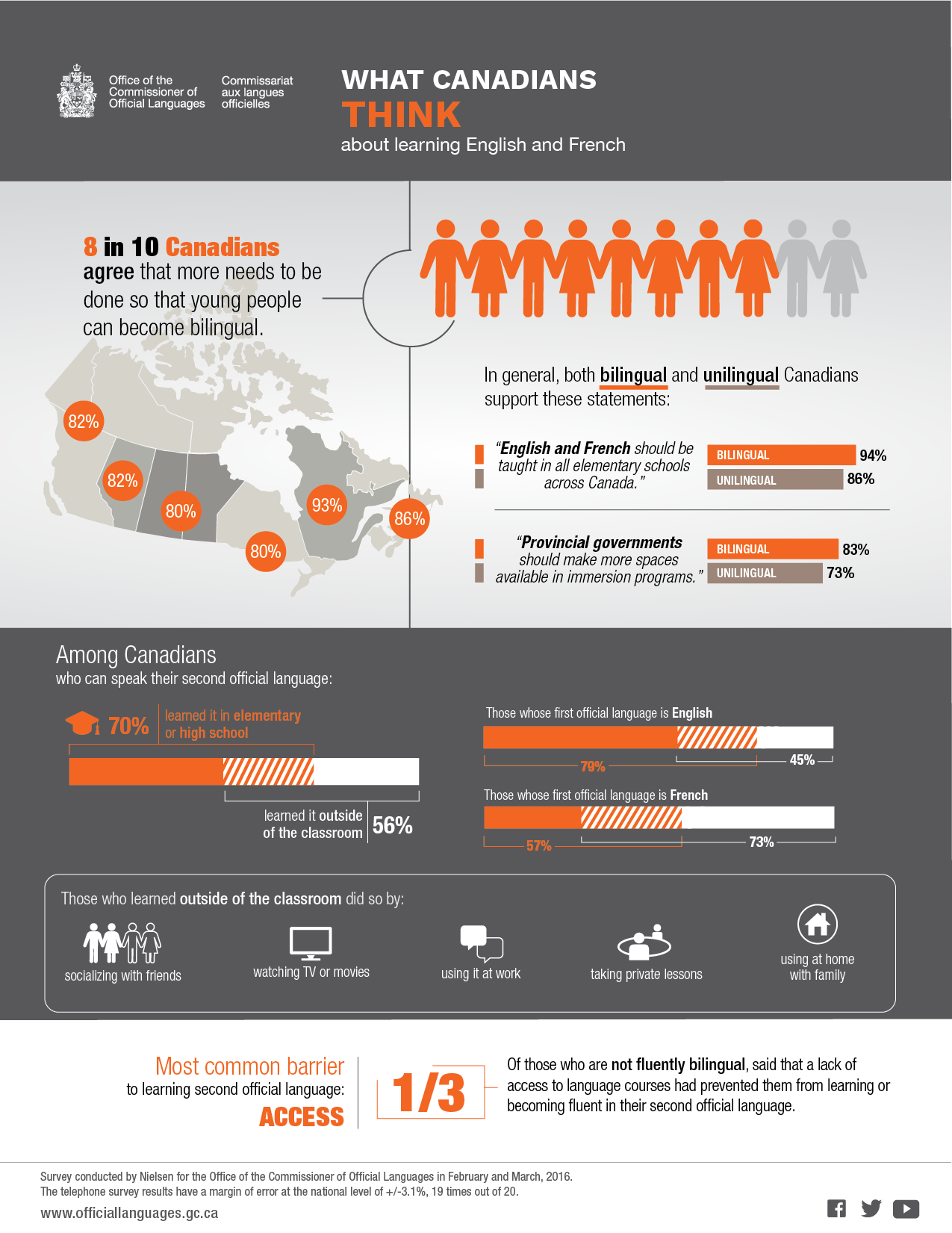
Canadians recognize the need to promote bilingualism, especially among young people. A 2016 survey conducted by Nielsen for the Office of the Commissioner of Official Languages (the Commissioner's Office) found that approximately 8 in 10 Canadians agree that:
- both languages should be taught to some extent in all primary schools in Canada;
- more needs to be done so that young people can become bilingual; and
- provincial governments should offer more places in immersion programs.
Learning one's second official language in school is particularly important for Canadians whose first official language is English: in the same 2016 survey, 79% of English-speaking respondents who could speak French said they had learned the language in primary or secondary school. Respondents also identified lack of access to language courses as the most common barrier to learning a second official language.
Read the Full article here ... Office of the Commissioner of Official Languages



.svg)
.svg)

.svg)
.svg)